





Salinas-Monterey Report
On This Page
- A Message from the Director of the Office of Personnel Management
- I. Executive Summary
- II. Background
- III. Federal Wage System Pay Determination Process
- IV. Description of the Salinas-Monterey Wage Area
- V. Analysis of OPM Regulatory Criteria for Wage Areas
- VI. Local Wage Survey Results
- VII. Current Pay Flexibilities for Federal Wage System Employees
- VIII. Conclusion
Report To Congress: Salinas-Monterey, California, Federal Wage System Wage Area
A Message From The Director Of The Office Of Personnel Management
I am pleased to present the Office of Personnel Management's (OPM's) report to Congress on the Salinas-Monterey, California, Federal Wage System (FWS) wage area. This report was prepared in response to House Report 107-152, which accompanied H.R. 2590 (enacted as Public Law 107-67, November 12, 2001). In that report, the House Committee on Appropriations directed OPM to report on its intentions with regard to implementing a local wage area committee recommendation to abolish the wage area and combine it with the San Francisco wage area.
On December 20, 2001, OPM provided Congress with a status report on the Salinas-Monterey wage area advising that it has been our longstanding policy to make no changes in the boundaries of FWS wage areas without first seeking the advice of the Federal Prevailing Rate Advisory Committee (FPRAC). FPRAC is the statutory national labor-management committee responsible for advising OPM on matters affecting the determination of prevailing rates of pay for blue-collar Federal employees. My staff introduced a study of the Salinas-Monterey wage area at FPRAC early this year. On July 25, FPRAC completed its review. By consensus, FPRAC agreed that at this time the Government can best determine prevailing rates for Monterey and San Benito Counties by maintaining a separate Salinas-Monterey wage area. FPRAC has informed me that it intends to study the Salinas-Monterey wage area next year once it receives new information on commuting patterns from the 2000 census. FPRAC has asked that I notify Congress of the results of this study upon its completion.
Based on FPRAC's findings and my thorough review of this matter, I believe the Salinas-Monterey wage area is appropriately defined to determine prevailing rates for FWS employees in Monterey and San Benito Counties, California. The President's emphasis on the strategic management of human capital in the Federal Government places a renewed focus on the need for creative use of current human resources management flexibilities to address existing or potential recruitment or retention problems. OPM is not aware of any widespread recruitment or retention problems in the Salinas-Monterey wage area. However, a number of pay flexibilities are available for use by all Federal agencies to deal with any recruitment or retention problems they may experience with respect to the Government's blue-collar workforce, and our report highlights those flexibilities.
I want to thank the dedicated staff of OPM's Workforce Compensation and Performance Service and the members of the Federal Prevailing Rate Advisory Committee for their work in reviewing this issue and preparing this report. The report can be found on the OPM Web site at Federal Wage System.
Kay Coles James
Director
I. Executive Summary
House Report 107-152 accompanying H.R. 2590 (enacted as Public Law 107-67, November 12, 2001) directed the Office of Personnel Management (OPM) to report on its intention concerning the geographic wage area definition of the Salinas-Monterey Federal Wage System (FWS) wage area. This report presents OPM's findings and recommendations concerning the definition of the Salinas-Monterey FWS wage area.
The FWS is a pay system that now covers about 206,000 trade, craft, and laboring employees who are paid from appropriated funds. About 420 FWS employees work in the Salinas-Monterey wage area. The goal of the FWS is to set pay rates for blue-collar Federal workers in line with local private sector labor market rates. By law, OPM defines the boundaries of FWS wage areas after consulting with the Federal Prevailing Rate Advisory Committee (FPRAC), the national labor-management committee responsible for advising OPM on matters affecting the determination of prevailing rates for blue-collar Federal employees. OPM initiates a system-wide review of FWS wage area boundaries at FPRAC every 10 years. However, any of the committee members may introduce a proposal to review the boundaries of a wage area at any time.
Each of the 132 separate FWS wage areas has a local wage survey committee that conducts local wage surveys and makes recommendations to the Department of Defense (DOD) on matters relating to the conduct of surveys in the wage area. The Local Wage Survey Committee for the Salinas-Monterey wage area recommended that OPM abolish the Salinas-Monterey wage area. We understand this recommendation is based in part on the fact that Monterey County is included as an "area of application" to the San Francisco-Oakland-San Jose, California, General Schedule (GS) locality pay area.
Different statutory authorities provide separate policies, principles, and criteria for defining FWS local wage area and GS locality pay area boundaries. Based on the advice of FPRAC, OPM has well-established regulatory criteria for defining FWS wage area boundaries on a consistent, system-wide basis. These criteria allow for reasonable flexibility, but also ensure that OPM is able to maintain an equitable, market-based pay system for blue-collar Federal employees. OPM's analysis of the criteria for defining FWS wage area boundaries indicates that the Government can best determine local prevailing rates for FWS employees in Monterey and San Benito Counties by maintaining a separate Salinas-Monterey wage area. OPM's next study of the definition of the Salinas-Monterey wage area will take place when we receive new census data next year.
II. Background
Blue-collar Federal workers have been paid according to local prevailing private sector rates since the Civil War. A separate wage area for blue-collar Federal workers has existed for Monterey County, California, for decades. Until 1965, each Federal agency had authority to determine local prevailing rates and establish wage area boundaries for its employees. As a consequence, blue-collar Federal workers at the same grade level in the same city working for different agencies were paid different rates. In 1965, President Lyndon B. Johnson addressed this inequity by ordering Federal agencies to coordinate their wage-setting activities under the leadership of the Civil Service Commission. The Commission established the National Wage Policy Committee (NWPC), made up of the heads of the major employing agencies and the heads of the major Federal employee unions, to seek advice on how to merge separate agency pay systems and create a Coordinated Federal Wage System (CFWS). One of the major projects undertaken by the NWPC was to establish criteria for defining the geographic boundaries of the CFWS wage areas. The NWPC recommended that the Commission establish the Salinas-Monterey wage area as a separate wage area.
In 1972, President Richard M. Nixon signed Public Law 92-392, which established the current Federal Wage System (FWS) under section 5341 et seq. of title 5, United States Code. The FWS incorporated most of the existing administrative policies of the CFWS. Since 1972, the Commission and its successor agency, the Office of Personnel Management (OPM), have been responsible for overseeing the administration of the FWS. The FWS now covers about 206,000 trade, craft, and laboring employees who are paid from appropriated funds. These employees are located in 132 separate wage areas throughout the country and in overseas areas.
One of the key statutory principles underlying the FWS is that pay rates are to be maintained in line with prevailing levels of pay for comparable levels of work in the private sector within a local wage area. To carry out this statutory principle, the Department of Defense (DOD) conducts annual wage surveys of private sector employers in each local wage area to determine local prevailing rates. By law, representatives of employee labor organizations are involved in all aspects of the prevailing rate pay-setting process. This involvement extends to the employee unions having a role in defining the boundaries of the FWS wage areas where DOD collects wage data.
The law requires OPM to define the geographic boundaries of FWS wage areas. Generally, separate FWS wage areas exist where large concentrations of Federal employment coincide with concentrations of private sector employment adequate to determine local prevailing rates. OPM consults with the Federal Prevailing Rate Advisory Committee (FPRAC) on all aspects of administering the FWS, including setting local wage area boundaries. FPRAC is composed of five representatives from agency management, five representatives from Federal employee labor unions, and an independent Chairman.
In 1972, based on the recommendations of FPRAC, the Commission continued the Salinas-Monterey CFWS wage area as a separate FWS wage area. FPRAC has not recommended any changes in the definition of the Salinas-Monterey wage area since that time. OPM has never changed the definition of an FWS wage area without receiving a recommendation from FPRAC to do so. In recent years, the Salinas-Monterey Local Wage Survey Committee (LWSC) has recommended that the Salinas-Monterey wage area be combined with the San Francisco wage area. The LWSC bases its recommendation in part upon its finding that General Schedule (GS) employees in Monterey County are in the San Francisco-Oakland-San Jose, California, GS locality pay area. Generally, the 31 white-collar locality pay areas that cover major metropolitan areas are larger than the blue-collar wage areas in those locations, and it is not unusual for more than one blue-collar wage area to be contained within the boundaries of a single white-collar pay area.
This report contains information on the process OPM uses to define FWS wage area boundaries, an analysis of the criteria OPM regularly applies when defining wage area boundaries, an analysis of local labor market conditions in the Salinas-Monterey and San Francisco FWS wage areas, and our recommendations on the definition of the two counties of the Salinas-Monterey wage area.
III. Federal Wage System Pay Determination Process
The FWS pay determination process is maintained through the cooperative efforts of agency management and employee organization representatives. By law, employee representatives are active at every level of the pay determination process. Several levels of responsibility have been established for the efficient management of the prevailing rate determination process. OPM establishes Governmentwide policies. The Department of Defense serves as the agent for FWS wage surveys and establishes FWS wage schedules following OPM's policies and procedures. In each of the 132 appropriated fund wage areas, a local wage survey committee is responsible for carrying out local wage surveys under OPM and DOD guidelines.
Under 5 U.S.C. 5343, the Director of OPM is responsible for defining FWS wage area boundaries. In practice, OPM defines FWS wage area boundaries based on recommendations of FPRAC. OPM frequently receives inquiries from members of the public, employees, union representatives, local wage survey committees, Federal agency representatives, and Members of Congress on how and why FWS wage area boundaries are set the way they are. OPM frequently receives recommendations on how an interested party thinks a particular wage area should be defined.
OPM listens carefully to recommendations on wage area boundaries and keeps track of where concerns originate. However, OPM acts to change the definition of an FWS wage area only after receiving advice from FPRAC. OPM has established regulatory criteria that FPRAC uses as the basis for making recommendations on FWS wage area boundaries. For FPRAC to consider a proposal to change an FWS wage area boundary, a member of the Committee must introduce the matter for discussion. Any labor or management member of FPRAC may introduce a subject for discussion by the Committee. OPM initiates a review of FWS wage area boundaries following each census. The next system-wide review of FWS wage area boundaries will begin in 2003 after we receive new demographic information from the 2000 census.
We have received recommendations from employees, union representatives, and Members of Congress concerning the definition of the Salinas-Monterey wage area. For the last few years, the Local Wage Survey Committee for the Salinas-Monterey wage area has recommended that the wage area be abolished and its counties combined with the San Francisco wage area. The Local Wage Survey Committee based its recommendation on factors such as the number and types of companies in the Salinas-Monterey wage area, the types of work performed in local private sector companies, the cost of living in the wage area, and the fact that white-collar Federal employees in Monterey are included in the San Francisco-Oakland-San Jose, CA General Schedule locality pay area.
The members of FPRAC have not supported the abolishment of the Salinas-Monterey wage area in the past because it meets all of the criteria recommended by the Committee to remain a separate wage area. None of the employee or agency representatives on FPRAC have requested further review of the definition of the Salinas-Monterey wage area based on the Local Wage Survey Committee's recommendations. OPM plans to initiate a review of all FWS wage area boundaries, based on new census data, in 2003. However, because of the continuing interest in the definition of this wage area, OPM recently presented the Salinas-Monterey wage area issue to FPRAC for its consideration. The following sections of this report describe the Salinas-Monterey wage area, local wage survey findings for the wage area, and the existing pay flexibilities available to Federal agencies to ensure that they are able to attract and retain a qualified workforce.
IV. Description of the Salinas-Monterey Wage Area
Blue-collar Federal employees in the Salinas-Monterey wage area have been paid rates that prevail in Monterey County for decades. For many years, Fort Ord conducted local wage surveys in the wage area. Upon Fort Ord's closure in the early 1990s, the Naval Postgraduate School in Monterey assumed responsibility for conducting local wage surveys in the wage area.
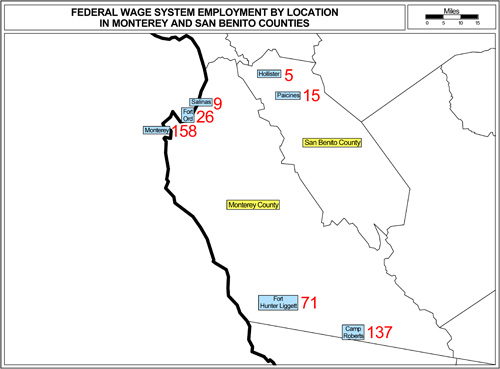
There are now about 420 FWS employees in the Salinas-Monterey wage area. About half of these employees work in the northern part of Monterey County, and about half work in the southern part of Monterey County. The Naval Postgraduate School, Fort Hunter Liggett, and Camp Roberts are the main FWS employers in the wage area.
Each FWS wage area consists of a survey area and an area of application.
- A survey area includes the counties, townships, and cities where the lead agency in the wage area collects and analyzes private sector wage data to produce a wage schedule for the wage area. The survey area for the Salinas-Monterey wage area is Monterey County. The rates of pay on the Salinas-Monterey wage schedule are determined based on prevailing private sector pay rates in Monterey County.
- An area of application includes the survey area and nearby counties, townships, and cities where the wage schedule also applies. The area of application for the Salinas-Monterey wage area is Monterey and San Benito Counties.
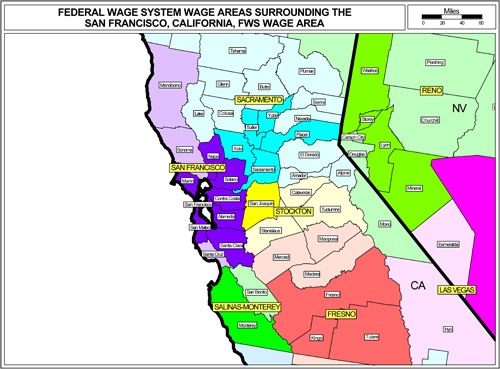
The map on the following page shows the FWS wage areas in central California. The darker shaded areas are survey areas, and the lighter shaded areas are areas of application to the corresponding survey areas.
There are five FWS wage areas in central California. FWS wage areas are not defined on a regional basis, but on a local basis, because FWS employees must, by law, receive local prevailing rates. As in other parts of the country, OPM defines FWS wage areas in central California where concentrations of FWS employment coincide with concentrations of private sector employment. Normally, a major military installation or Department of Veterans Affairs Medical Center serves as the nucleus of an FWS wage area. The standards OPM uses for establishing FWS wage areas and the procedures for conducting FWS wage surveys to determine local prevailing rates are based on the recommendations of FPRAC. OPM has never changed the standards and procedures for determining FWS pay rates without first seeking the advice of FPRAC.
V. Analysis of OPM Regulatory Criteria for Wage Areas
As mentioned earlier in this report, the Civil Service Commission defined the original FWS wage area boundaries in 1972 based on recommendations of FPRAC. FPRAC developed criteria for establishing and maintaining FWS wage areas on a consistent basis across the country. These criteria allow for a reasonable degree of flexibility, but are applied consistently throughout the pay system to ensure that similarly situated FWS employment sites are treated in as similar a manner as possible.
OPM has abolished FWS wage areas in the past based on the advice of FPRAC only when a lead agency no longer has the ability to conduct local wage surveys in the area or the lead agency consistently is unable to collect sufficient wage data in the area to meet survey adequacy requirements set by OPM. The criteria for establishing a wage area take into account FWS employment and private sector employment in an area.
Under 5 CFR 532.211(c), OPM establishes wage areas when-
(1) A minimum of 100 wage employees of one agency are subject to the regular schedule, and the agency involved indicates that its local installation has the capacity to do the survey; and
(2) There is, within a reasonable commuting distance of the concentration of Federal employment-
(i) A minimum of 20 establishments (within survey specifications) having at least 50 employees each or 10 establishments having at least 50 employees each, with a combined total of 1,500 employees; and
(ii) The total private enterprise employment in the industries surveyed in the survey area is at least twice the Federal wage employment in the survey area.
Salinas-Monterey meets criterion (1) because-
- The Salinas-Monterey wage area's host activity, the Naval Postgraduate School in Monterey, CA, has approximately 120 FWS employees and has the capacity to conduct local wage surveys in the Salinas-Monterey wage area.
Salinas-Monterey meets criterion (2) because-
- Within the survey area of the Salinas-Monterey wage area-
(i) 69 private industrial establishments exist with 50 or more employees (within survey specifications), with a combined total of approximately 19,686 employees; and
(ii) The total private enterprise employment in industries surveyed in the survey area is 247 times greater than the FWS employment in the survey area.
- The Salinas-Monterey survey area has more than a sufficient amount of private industrial establishments and private enterprise employment in the surveyable industries to qualify as an FWS wage area.
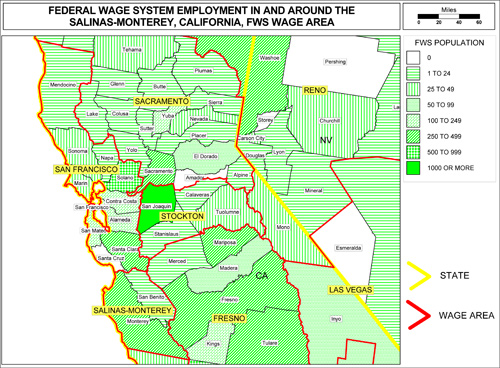
The two maps on the following pages show the distribution of FWS employees in and around the Salinas-Monterey wage area.
Based on the recommendations of FPRAC, OPM provides guidelines for determining the adequacy of wage survey data at 5 CFR.532.239(b)(1). Ordinarily, we consider a survey to provide adequate wage survey data when the results include data for-
- 1 survey job in the WG-1 through WG-4 range with 20 or more samples,
- 1 survey job in the WG-5 through WG-8 range with 20 or more samples,
- 2 survey jobs in the WG-9 through WG-15 range with 20 or more samples, and
- 6 other survey jobs with 10 or more samples in any grade range.
The chart below provides the wage survey data for the Salinas-Monterey wage area obtained by DOD during its most recent survey.
| Job Title | Federal Grade | Observations |
|---|---|---|
| Janitor (Light) | 1 | 34 |
| Janitor (Heavy) | 2 | 63 |
| Material Handler | 2 | 18 |
| Forklift Operator | 5 | 372 |
| Mat. Hand. Equip. Oper. | 5 | 26 |
| Warehouse Worker | 5 | 45 |
| Truckdriver (Medium) | 6 | 16 |
| Truckdriver (Heavy) | 7 | 155 |
| Automotive Mechanic | 10 | 45 |
| Electrician | 10 | 20 |
| Welder | 10 | 25 |
Local wage surveys in the Salinas-Monterey wage area have consistently met the criteria agreed upon by the labor and management members of FPRAC to remain a separate wage area. However, if local wage surveys in the Salinas-Monterey wage area prove to be inadequate under these criteria in the future, OPM has regulatory flexibilities to address survey adequacy problems. As a last resort, OPM may abolish a wage area and combine its constituent counties if, over a period of time, it proves impossible for DOD to determine local prevailing rates in the wage area.
While OPM has never abolished a wage area with a viable host installation that continues to meet survey adequacy requirements, OPM has made certain minor changes in wage area boundaries from time to time. In prior system-wide reviews of FWS wage area boundaries, the members of FPRAC have used OPM's regulatory criteria to analyze individual counties to determine whether minor changes in wage area definitions are appropriate.
Under 5 CFR 532.211(d), OPM may combine adjacent economic communities or political units meeting the separate wage area criteria by considering the following factors:
(1) Distance, transportation facilities, and geographic features.
A distance of 115 miles (185 kilometers) separates the city of Monterey from the city of San Francisco. The major FWS employment sites, Camp Roberts and the Naval Postgraduate School, are 200 miles (322 kilometers) and 115 miles (185 kilometers), respectively, from San Francisco.
An Interstate highway connects the Salinas-Monterey and San Francisco survey areas, and no geographic features present significant obstacles to travel between the two wage areas.
(2) Commuting patterns.
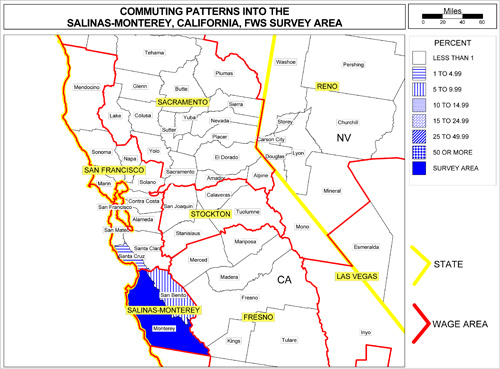
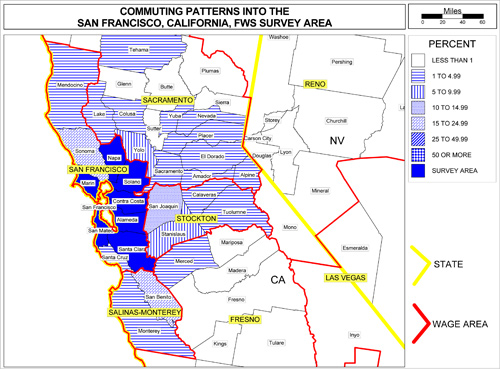
The following two maps show the percentage of workers commuting into the Salinas-Monterey and San Francisco survey areas based on 1990 commuting patterns census data. The maps show very little linkage between the Salinas-Monterey and San Francisco FWS wage areas based on commuting pattern data.
Commuting patterns indicate that 92 percent of the resident workforce in the Salinas-Monterey survey area lives and works in the Salinas-Monterey survey area (Monterey County) and that only 2 percent of the resident workforce in the Salinas-Monterey survey area commutes to work in the San Francisco survey area. Sixteen counties not currently included in the San Francisco wage area have similar or higher percentages of their resident workforces commuting to jobs in the San Francisco survey area when compared to Monterey County.
We received information from representatives of employees at the Naval Postgraduate School that larger numbers of people are expected to commute within the four-county area of Monterey, San Benito, Santa Clara, and Santa Cruz Counties in the future. The Association of Monterey Bay Area Governments predicts that the Monterey Bay area will experience a steady increase in population, jobs, and housing through 2020. OPM's review of commuting patterns is hampered at this time because of the lack of available data on commuting from the 2000 census. While we do not have sufficient information to indicate that there is a significant linkage between the Salinas-Monterey and San Francisco FWS wage areas at this time, we will be able to assess this factor more completely after we receive new census data next year.
(3) Similarities in overall population, employment, and the kinds and sizes of private industrial establishments.
The chart below compares the overall population, employment, and the kinds and sizes of private industrial establishments in the Salinas-Monterey and San Francisco survey areas.
| Survey Area | Population ---- Total Workforce |
Manufacturing | Transportation/ Communications/ Utilities |
Wholesale Trade |
|||
|---|---|---|---|---|---|---|---|
| Employment All Size Groups | # of 50+ Establishments | Employment All Size Groups | # of 50+ Establishments | Employment All Size Groups | # of 50+ Establishments | ||
| Salinas-Monterey, CA | 355,660 ---- 99,599 |
6,751 | 24 | 4,935 | 19 | 8,000 | 26 |
| San Francisco, CA |
5,635,355 --- 2,810,721 |
387,704 | 1,276 | 156,607 | 471 | 189,555 | 671 |
These data show that the survey areas are markedly different, with the San Francisco survey area having a population more than 15 times greater and a total workforce more than 28 times greater than the Salinas-Monterey survey area. Employment in manufacturing establishments in the San Francisco labor market is more than 57 times greater than in the Salinas-Monterey labor market; employment in transportation, communications, and utilities establishments is more than 31 times greater; and employment in wholesale establishments is more than 23 times greater.
In addition, the following chart shows the survey area's distribution of private sector employment in the manufacturing, transportation, and wholesale trade sectors.
| Survey Area | MANUFACTURING | TRANSPORTATION AND PUBLIC UTILITIES |
WHOLESALE TRADE |
|---|---|---|---|
| Salinas-Monterey Survey Area |
34% | 25% | 41% |
| San Francisco Survey Area |
53% | 21% | 26% |
These data show that the survey areas also have different distributions of private sector employment in surveyable industries. The Salinas-Monterey survey area has a higher proportion of employment in the wholesale trade sector than the San Francisco survey area, while the San Francisco survey area's proportion of employment in the manufacturing sector almost doubles that of the Salinas-Monterey survey area. With such dissimilar industrial and employment patterns, we do not believe it would be appropriate to base pay rates for FWS employees in the Salinas-Monterey wage area on prevailing rates in the San Francisco survey area.
The Local Wage Survey Committee for the Salinas-Monterey wage area expressed concern that there are not enough private industrial establishments in the Salinas-Monterey wage area to serve as a viable survey base and that the establishments in the wage area are primarily associated with the manufacture and distribution of food products. However, FWS wage surveys in the Salinas-Monterey and San Francisco wage areas include establishments in the manufacturing; transportation, communications, electric, gas, and sanitary services; and wholesale trade industries. As can be seen in the chart above, the Salinas-Monterey wage area does not have the same industrial base as the San Francisco wage area, but the number of establishments in the Salinas-Monterey wage area is sufficiently varied to meet OPM's regulatory criteria for determining local prevailing rates. The Local Wage Survey Committee's position in this respect is in conflict with OPM's criteria for wage survey adequacy. While OPM could change its criteria for system-wide survey adequacy based on an FPRAC recommendation, we have not had an indication from the Committee that the criteria are flawed. Any changes in these criteria would have system-wide ramifications for the pay system which are beyond the scope of this report. The Committee has not expressed a desire to revisit the appropriateness of the survey adequacy criteria.
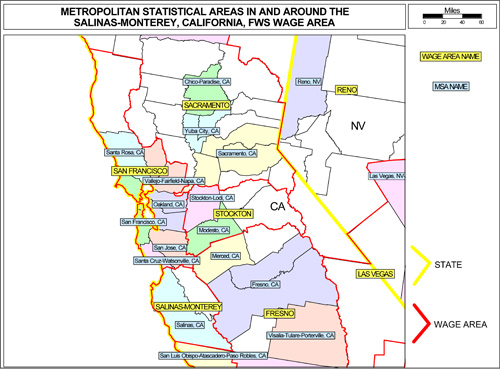
In reviewing FWS wage areas, OPM considers changes in Metropolitan Statistical Areas (MSAs) and Primary Metropolitan Statistical Areas (PMSAs). Under OPM's regulations, wage area boundaries will not split MSA boundaries except in unusual circumstances. The next map shows the current metropolitan areas as defined by the Office of Management and Budget (OMB) in and around the Salinas-Monterey wage area. The Salinas-Monterey wage area includes one MSA-the Salinas, CA MSA. The Salinas-Monterey wage area boundary does not split the boundary of any MSA. As shown on the following map, the OMB MSA and PMSA definitions consider the primary portions of the Salinas-Monterey and San Francisco wage areas to be separate entities.
VI. Local Wage Survey Results
Because the FWS is a prevailing rate system, its wage schedules are very market sensitive. It is the policy of the Federal Government to pay its blue-collar workers a fair wage that is comparable to what an employee could expect on average to earn for work at a similar level of skill in local private sector companies. The local wage surveys in the Salinas-Monterey and San Francisco wage areas show that the prevailing private sector rates of pay are different in the wage areas and that the private sector labor markets are different.
The chart below shows the current unrestricted hourly pay rates (prevailing market rates) for FWS wage grade (WG) employees at step 2 of the wage schedules in the Salinas-Monterey and San Francisco wage areas. These rates are derived from private sector pay rates for sample wage survey jobs.
| Grade | Salinas-Monterey Wage Area | San Francisco Wage Area |
|---|---|---|
| WG - 1 | $11.10 | $11.33 |
| WG - 2 | $11.99 | $12.57 |
| WG - 3 | $12.89 | $13.81 |
| WG - 4 | $13.78 | $15.05 |
| WG - 5 | $14.67 | $16.29 |
| WG - 6 | $15.56 | $17.54 |
| WG - 7 | $16.45 | $18.78 |
| WG - 8 | $17.34 | $20.02 |
| WG - 9 | $18.24 | $21.26 |
| WG - 10 | $19.13 | $22.50 |
| WG - 11 | $20.02 | $23.75 |
| WG - 12 | $20.91 | $24.99 |
| WG - 13 | $21.80 | $26.23 |
| WG - 14 | $22.69 | $27.47 |
| WG - 15 | $23.59 | $28.71 |
The chart on the next page shows the average private sector hourly pay rates for FWS survey jobs common to both the Salinas-Monterey and San Francisco wage surveys. It demonstrates that the average private sector pay rates for survey jobs in the Salinas-Monterey survey area are generally lower than in the San Francisco survey area.
| Survey Job Title | Salinas-Monterey | San Francisco Wage Area |
|---|---|---|
| Janitor (Light) | $10.25 | $12.58 |
| Janitor (Heavy) | $11.00 | $14.80 |
| Material Handler | $14.12 | $20.32 |
| Warehouse Worker | $16.10 | $15.39 |
| Forklift Operator | $13.67 | $15.18 |
| Truckdriver (Medium) | $12.47 | $13.59 |
| Truckdriver (Heavy) | $21.00 | $20.99 |
| Electrician | $23.22 | $21.92 |
| Automotive Mechanic | $16.44 | $24.43 |
| Welder | $16.51 | $18.58 |
Based on DOD's survey findings, we believe the Salinas-Monterey survey area has a distinct and established private sector labor market that produces adequate wage rates to determine the prevailing private sector cost of labor in the wage area.
Employee representatives from the Naval Postgraduate School presented information from State and local government activities that shows that, in some cases, non-Federal Government employees earn more than FWS employees in the Salinas-Monterey wage area. By law, FWS wage surveys may include private sector establishments only. FWS wage surveys may not include data from any non-Federal Government employers in a wage area. Employee representatives also cited 2000 data published by the Bureau of Labor Statistics (BLS) for its Occupational Employment Statistics program to show that certain selected occupations in the Salinas-Monterey wage area receive higher pay rates than in the San Francisco wage area.
There is no direct comparison between the methodologies used in FWS wage surveys and in BLS' survey programs. However, the overall trends from BLS' Occupational Employment Statistics program show certain parallels with the findings from FWS wage surveys in the Salinas-Monterey and San Francisco wage areas. For example, the estimated mean hourly wage for "Installation, Maintenance, and Repair Occupations" in 2000 was $19.18 in the San Francisco metropolitan area and $17.18 in the Salinas metropolitan area. In the category "Transportation and Material Moving Occupations" in 2000, the mean hourly wage was $15.02 in the San Francisco metropolitan area and $11.72 in the Salinas metropolitan area. In the category "Building and Grounds Cleaning and Maintenance Occupations" in 2000, the mean hourly wage was $11.54 in the San Francisco metropolitan area and $10.10 in the Salinas metropolitan area.
VII. Current Pay Flexibilities for Federal Wage System Employees
In almost all cases, the rates of pay provided by FWS wage schedules are sufficient to allow Federal activities to recruit and retain employees. Because the FWS is a prevailing rate system, it is very rare for FWS pay rates to be out of line with private sector rates to the extent that the Federal Government actually experiences recruitment or retention difficulties. In any case, recruitment or retention difficulties within a wage area are not among the criteria OPM considers when defining FWS wage area boundaries. Nevertheless, Federal agencies have considerable discretionary authority to provide additional direct compensation in certain circumstances to support their recruitment, relocation, and retention efforts. The following summarizes some of these compensation flexibilities as they apply to the FWS:
- Special qualifications appointments allow an agency to hire unusually well qualified candidates at higher than the first step of the appropriate grade level.
- The increased minimum hiring rate authority allows the lead agency to establish a step higher than the first step as the minimum step at which a new employee may be hired.
- The special rate authority allows an agency to request OPM approval to establish rates above the regular wage schedule for an occupation or group of occupations.
- The special schedule authority allows an agency to request OPM approval to establish a higher schedule of rates in a manner generally broader in scope than under the special rate authority.
- Recruitment and relocation bonuses allow an agency to pay up to 25 percent of basic pay to fill a position that would otherwise be difficult to fill.
- Retention allowances allow an agency to pay up to 25 percent of basic pay to an employee who would be likely to leave the Federal Government in the absence of a retention allowance.
- The unrestricted rate authority allows an agency to ask OPM to waive the annual statutory cap on FWS pay adjustments for an occupation or group of occupations in a wage area or a part of a wage area.
We believe these pay flexibilities are sufficient for Federal agencies to recruit and retain FWS employees. We strongly encourage Federal agencies to use the existing pay flexibilities to address any recruitment or retention problems that may exist within a local wage area.
VIII. Conclusion
The Office of Personnel Management (OPM) has well-established regulatory criteria for defining Federal Wage System (FWS) wage area boundaries on a consistent basis. These criteria allow for reasonable flexibility, but also ensure that OPM is able to maintain an equitable, market-based pay system for blue-collar Federal employees. The Federal Prevailing Rate Advisory Committee has not supported the abolishment of the Salinas-Monterey wage area in the past because it meets all of the criteria recommended by the Committee to remain as a separate wage area. OPM's analysis of the criteria for defining FWS wage area boundaries indicates that the Government can best determine local prevailing rates for FWS employees in Monterey and San Benito Counties by maintaining a separate Salinas-Monterey wage area. As part of an ongoing long-term cyclical review process, OPM's next study of the definition of the Salinas-Monterey wage area will take place after we receive new census data in 2003.