


ICYMI: Director Kupor Discusses Responsible SI Leadership on CNBC’s Squawk Box
WASHINGTON, DC – US Office of Personnel Management (OPM) Director Scott Kupor, Vice Chair of the Super Intelligence Task Force, joined CNBC’s Squawk Box to discuss the task force’s work, technology companies’ responsibilities, government oversight, the impact of data centers, and the need to advance super intelligence responsibly.
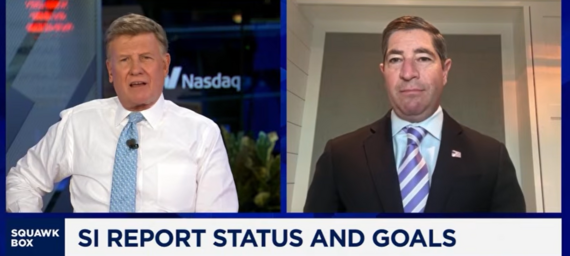
On the task force’s goals:
“Thanks, Joe. You’re exactly right. The goal is to make sure that we continue to win, which we are winning, and ensure that we do so responsibly. I think what you’re going to see from us are a couple things. One is—and I just saw the last segment you guys did—there’s a lot of work on behalf of the industry that needs to happen.”
On industry responsibility:
“We’ve been very clear from the beginning, and you’ll see us continue to follow up. The industry bears a lot of responsibility here to make sure that when they release things, they’re safe, they’re appropriately vetted, and when things go wrong, you’re going to see us make sure that there’s a very appropriate ongoing notification program so that the government has all the information they need.”
“We’re also going to make sure that all the major players outside of technology—critical infrastructure, financial services, energy, oil and gas, all these companies—have the appropriate information they need to make sure that they’ve got plans in place and that we’ve got coordination across things.”
“There’s a whole set of laws that the President has mentioned—product liability laws, principal-agent laws, all these things that really govern corporate responsibility in these areas. I think you’re going to see a much greater articulation of that and an indication among the companies that the government has a very clear expectation of their responsibility here.”
On enforcement and oversight:
“You’re right. That was with a pact that was signed, I guess, a week ago Tuesday with the various players. These are independent auditors. They will report to the board, and all the traditional fiduciary duties and corporate responsibilities will attach to that.”
“But there’s also got to be a mechanism whereby the government actually has insight into that and appropriate oversight. We’re not just going to sit around and wait for the companies to tell us they’ve done their work. I think you should expect that the government should have a role in making sure that what the companies say they do, they do, and that there’s an appropriate mechanism for enforcement on our end.”
On data center energy and water use:
“Water and energy—we’ve seen this already, even in the data that’s come out. There’s no question that whatever concerns there traditionally were about energy usage and water use, all those are going in the right direction, meaning the technology continues to improve and will reduce those.”
“To be completely honest, I think this is the easiest part of the problem to solve. The players in this space should just go into those local communities and say, ‘Look, we don’t need to debate whether water is going to get better or energy is going to get better. We should just take care of that.’”
“If you’re concerned about rate rises, we’ll take care of those. If you’re concerned about electricity, we can either bring our own or, again, we can take care of those rates. We don’t need to debate these topics. I imagine no average American is going to read the studies on water usage. So let’s just take these things off the table.”
“We’ve been very clear with the industry on this as well. We think this is a much easier problem to solve. They should just go in and resolve these issues. Yes, absolutely, the technology will take care of these problems over time, but in the meantime, there’s a much simpler way to do this: companies should make sure those concerns are taken right off the table.”
On harnessing SI innovation:
“I think you can do both things. You’re absolutely right: The power of this will be that, over time, the recursive nature of the idea—that it can learn from mistakes—will continue to evolve the technology.”
“You’ve been around a long time, as you probably know. Many technology industries develop in this area. In the early stages of these companies, there are lots of challenges that need to be dealt with. For every challenge out there, I can tell you there’s somebody on Sand Hill Road trying to start a company to address it.”
“The technology will evolve not just in terms of the benefits, but also around security control and all these other areas. Nvidia put out, about a week and a half ago, an open-source piece of software that would prevent things like the jailbreaks that happened in the Hugging Face case. The industry is going to have to—and I’m very confident it will—continue to release products that deal with these issues as they come up.”
“In the short term, obviously, we do need to make sure that we’ve got the appropriate level of government oversight, that there is a notification scheme, an information scheme, and the government has all the information required to make sure that public safety remains a number one concern.”
On industry views and the risk of slowing down:
“I’m not going to ascribe motivations or try to discern those for those individuals. Those are extremely smart people who, as you know, probably have lots of—”
“I think that’s a fair point, and I get that. What’s really important for these players to understand is a couple things. Number one, if Dario and others really honestly believe that they are putting products out that they are fundamentally unable to control and that actually are going to cause harm to people, there is a very strong existing set of laws and regulations that should prohibit that behavior, and those companies need to understand that.”
“If he’s got questions and concerns, the issue is: Can we evolve the technology and make sure that we can address those? I think that’s a totally different story, and I think there is a role for the government to play here to make sure that they stand by those ideas.”
“I think everybody’s going to have different motivations on this. At the end of the day, the fundamental question the President has asked us is this idea of a pause or a slowdown. What is the impact of that?”
“There is no magical kill switch somewhere where, if we decide to slow this down, that doesn’t mean other adversaries won’t continue to advance the technology. That’s not a good place for us to be. What’s critical is that we allow the technology to develop, but we’ve got to do so in a responsible way.”
“Different players in this area have different views on it. Part of our job, which is why we’re here, is we’ve got to coalesce those views and make sure we have a plan that protects the American people.”