





ICYMI: OPM Director Scott Kupor Discusses the Super Intelligence Force on CNN’s The Lead with Jake Tapper
WASHINGTON, DC – US Office of Personnel Management (OPM) Director Scott Kupor joined The Lead with Jake Tapper on CNN to discuss President Trump’s Super Intelligence Force, the administration’s approach to SI safety and innovation, and how the government can prepare for potential risks and workforce changes.
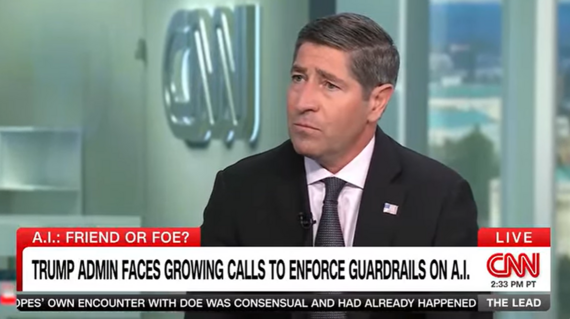
On President Trump’s use of the term “super intelligence”:
“No. Yes. I can’t protect you, you know. But yes, SI is the new word.”
On whether companies will change their names:
“I don’t know. But you may have seen Elon did, right? So Elon changed the name of his company. He’s now calling it X SI, I believe.”
On whether there will be punishment for using the term “artificial intelligence”:
“I don’t know. You got to ask the President that. I’m not briefed on that to talk to you about today.”
On the industry’s voluntary safety commitments and the task force’s role:
“Yes. I would say a couple of things. First of all, it’s not just, you know, they’re responsible for their own stuff. As part of that contract they signed, they agreed that they would have external third-party auditors reviewing it. And as you probably know, obviously, if you sit on a public company board in particular, outside auditors typically report to the board of directors.
“And so if an outside security auditor comes back to these companies and says, ‘Hey, we got a problem here,’ that board’s going to have to actually respond and do something. So it is truly legally binding in that respect, which is all the traditional fiduciary duties and kind of duties that board owes.
“The second thing I would just add is, look, as I know we’ll talk about, the President put together this SI force that myself and three others—”
“Jay Clayton, Emil Michael, and Andrew Ferguson at the FTC are running. I think you should expect that. Look, we’re not going to sit around and just say, ‘Great, we’re wonderful. We’re thrilled you guys signed this piece of paper,’ and, you know, we should just be done and dusted.
“The whole purpose of this committee is to figure out, OK, what is the comprehensive set of policies that we think meet the dual goals that the President has? Which is, look, the President thinks we should continue to win. I certainly believe this is an important fight and a battle that we should win.
“But he’s also said we need to figure out how to do it in a way that’s responsible to the economic and natural sovereignty needs of the American people. So that’s what we’re going to obviously balance as part of this.”
On reporting incidents involving SI models:
“Yes. So this is definitely one of the things that we are going to take up as part of this task force. We need to make sure we have an appropriate, let’s call it a notification paradigm, for lack of a better word. So, we want to encourage the companies—and you’re seeing this more and more now—we want to encourage the companies to have a paradigm where they say, ‘Look, when we see something, report it to us.’
“And then, look, it’s incumbent upon us as the government then to make sure, OK, what do we do with that information? So is it an FAA issue? So we’ve got to go talk to the Department of Transportation, make sure they know what’s happening. So, again, a lot of what we’re going to try to do is talk to, obviously, the model companies, talk to all the agencies in the government, including the intelligence agencies, figure out what they need.
“We’re also going to go talk to—and this is where I’m going to spend my time—all the various other infrastructure companies, so financial services, oil and gas companies, energy companies, anybody for whom some type of security-related incident might obviously turn into a major issue.
“And we’ve got to figure out a notification system, we’ve got to figure out a communication system, and ultimately action plans to make sure that the American people feel that they can—they’re safe and they can trust the technology.”
On preparing workers for potential changes to the labor market:
“Yes. So one thing I would just note is, look, so far to date, if you rewind the clock about 18 months ago, people like Dario, for example, were actually talking about a coming job apocalypse. So far, actually, if you look at jobs, what all the data has shown is that actually we’ve increased jobs as a result of SI.”
“And I hope that’s true too, right? And that’s—and that’s, as you well know, look, when you look at most technological changes, that’s what happens. But I agree with you, people are concerned about it. What you have seen and what you will see more from the Department of Labor is there are a bunch of retraining programs that are happening, and you will see us address this very, very directly as part of the work that we’re doing in our task force.”
On addressing risks from bad actors and cyberattacks:
“Yes. So I think there’s a couple things, again, that you’ll see us enact as part of this task force. One is there is a whole set of laws and regulations that deal with kind of what you’re describing, the bad actor scenario. So, you know, DOJ has all kinds of criminal statutes, as does the FTC have civil ones.”
“I think there are. I think, look, every corporation has a very basic responsibility to make sure that when they put things out, they put things out that they deem safe and appropriate, you know, for consumer use. Now, look, if a bad actor comes along and takes technology, again, you know, we have the ability, of course, to go after that bad actor through existing criminal laws.
“On the other side, though, what’s really important is, you know, as you mentioned before, we’ve got to protect things on the cyber side as well. So, a lot of what you’re going to see us do is make sure we have a lot more teeth, you know, behind all the activities of the companies themselves. We have notification schemes. We will have, kind of, contingency plans across all the different agencies.
“And the goal will be to make sure that, you know, if it turns out that there’s something there, the government is going to be as well-educated and as well-prepared for this as we can be for any possible scenario.”