





OPM Director Kupor Delivers Opening Remarks During House Appropriations Subcommittee Hearing
WASHINGTON, DC — Today, US Office of Personnel Management (OPM) Director Scott Kupor testified before the House Appropriations Subcommittee on Financial Services and General Government, outlining the work OPM is doing to modernize the federal workforce, improve efficiency, and strengthen accountability across government.
|
|
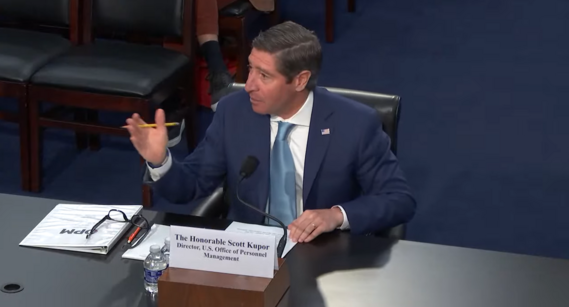
Remarks as delivered:
Thank you, Chairman Joyce, Ranking Member Hoyer, and as well, Ranking Member DeLauro, thank you for being here and members of the committee. It's an honor to be here today, and I appreciate the opportunity to appear in front of you and talk about the work of the Office of Personnel Management.
Since my confirmation last summer, as Mr. Hoyer you mentioned I’ve been here since July. I've tried to approach this role with the same mindset I brought from decades in the private sector. That means getting the fundamentals right people, systems, and culture, so the government can operate efficiently, innovate where it needs to, and earn the trust of every taxpayer.
Today, I'd like to zero in on the three of the priorities that are driving our efforts today at OPM and I look forward to your questions:
Number one is, ensuring that we have the right employees in the right roles, at the right time and in the right places across government.
Number two is, being good stewards of taxpayer dollars by modernizing the federal workforce ecosystem to eliminate outdated processes and systems that unfortunately waste time and money.
And third, its important for us to drive a high-performance culture where excellence is rewarded, accountability is real, and everyone is set up to do their best work every day.
Let's start with the first: having the right people in the right roles. As you know, this is the foundation of any high-performing organization, public or private. But in government, we've historically struggled even to get a clear picture of who we have and where the gaps are.
One of the early moves that we did in this administration was to replace what we call the outdated FedScope tool with the new Federal Workforce Data that we launched fairly recently on OPM.gov. The old system was clunky, it was hard to navigate, it often lagged months behind reality. This new portal delivers monthly updates, a much cleaner user experience, and real-time insights into workforce composition, demographics, and trends. For the first time, leaders across agencies, the public, and importantly members of Congress, can see the data clearly, when they want to see it and they can act on it.
With that visibility, we've now zeroed in on some critical weaknesses and challenges that I believe we have in the government. There’s no question that tech talent is an issue as well as early-career hires, these stand out as persistent pain points in the governement. One of the initiatives we’ve launched to try to address this is called Tech Force, this is a cross-government initiative to bring in 1,000 early-career technologists over two years. We hope these will be sharp, motivated engineers and developers who will embrace the new modernization activities that are happening across all the industries, HHS, Treasury, Department of War and others, and accelerate the efforts that were working on. We’ve designed this as a public-private partnership designed to inject fresh talent where it's needed most, while giving participants career development, speaker series, and exposure to both government missions and private-sector opportunities at the end of the program.
The numbers that we face today on the demographics tell a really important story. Today about seven percent of the federal workforce is early career or under the age of 30, on the other end of the spectrum nearly half of the federal workforce is over the age of 50. These numbers are wildly different from what the representations are in the broader workforce. On the seven percent that we have in government in comparison there are 23 percent of all American workers that are under the age of 30. By a factor of three to one, we have a very very important demographic imbalance that I believe is unsustainable. Without deliberate [action] to attract and develop the next generation, we risk an existential capability gap that will undermine our ability to effectively serve the American people in the years ahead. Tech Force is just the start program we have here. But we will roll out additional cross-government efforts to make sure that we can fill this gap and build a pipeline of talent that reflects America's future.
Our second priority is modernizing the federal workforce system. Right now, human capital is inefficient, we have more than 120 human capital systems across government, for which we spend billions of dollars, and we have poor data, duplicative data and that doesn’t make any sense.
We're tackling this head-on with a project that we call Core HCM, we are looking to bring a single instance of…human capital system into government to reduce cost, increase efficiency, and stop wasting resources on redundant systems.
In addition, we have more than 45,000 HR professionals in government, who spend an inordinate amount of their time trying to collect data out of outdated systems. And therefore, are unable to participate in helping employees actually achieve what we want, from a career development perspective and making sure that we have the right talent. The introduction of this new system will enable those HR professionals to be able to refocus their efforts in the areas we think are most important.
You mentioned, Mr. Hoyer, the retirement process, this has for a long time been a source of frustration, I’m sure it’s not new to any of you. This has been a paper system for 50 plus years, quite frankly it is an insult to hardworking federal employees as they transition into retirement. Many of these individuals have dedicated their entire federal careers to public service and we have done them a tremendous disservice in terms of how we’ve handled this.
We launched this year the online retirement application. More than 130,000 annuitants now have gone through that system and we are seeing incredible progress. We actually have doubled our productivity, in terms of the amount of applications that we can process and we’ve reduced our processing times by more than half.
This is critically important; at the same time, we have also made sure that every employee who is retiring within seven days has access to interim pay while their application is being adjudicated. That compares with 40 percent in the prior administrations. We want to make sure that the transition into retirement is respectful and important for others.
Finally, and perhaps most importantly, we're focused on building a high-performance culture. This starts with hiring. We've eliminated unnecessary proxies for merit, like rigid degree and tenure requirements, and shifted to functional and technical assessments that actually measure whether someone can do the job.
Retention and performance though go hand in hand. Today, performance management is broken. Nearly everyone in government gets ranked at the top of the system. 99.7 percent of employees every year are ranked at or above expectations, 0.3 percent of people are rankled below expectations. As wonderful as I agree that the federal workforce is, that is not a system that engenders accountability.
None of this is about politics, partisanship, or shrinking government for its own sake. It's about creating an environment where federal employees can come to work, do their best work every day, are held to clear standards and recognized for outstanding work. If we get the people right, we modernize the systems, and foster a culture of high-performance, we end up with a more efficient workforce… With that I will wrap up and look forward to your questions.